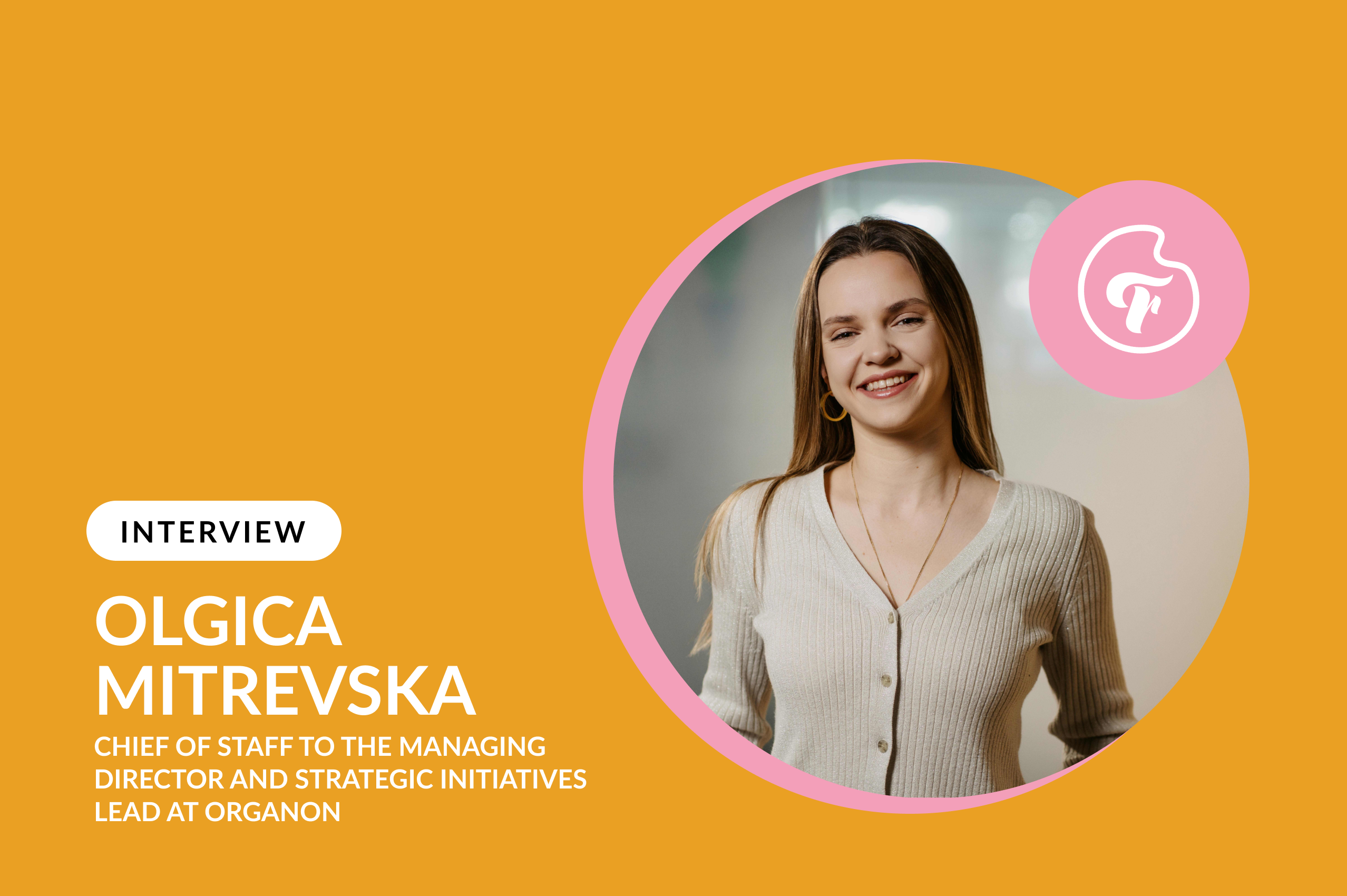
There's a quiet assumption a lot of women carry: that fertility is a topic for later, something to think about once everything else is handled, the promotion, the relationship, the right moment. Olgica Mitrevska, Chief of Staff to the Managing Director and Strategic Initiatives Lead for Organon's EEI Cluster, has seen where that assumption leads, and it's often not where you'd expect. By the time many women engage seriously with fertility, some options are already off the table, not because they weren't paying attention, but because no one told them the timeline sooner.
We talked to Olgica about Organon's Plodnost pod kontrolou (Fertility Under Control) initiative, why age-related fertility decline still catches so many women off guard, and why she believes fertility awareness belongs in the same conversation as career planning, not separate from it.
As the Chief of Staff to the Managing Director and Strategic Initiatives Lead for Organon’s EEI Cluster, I work across 21 markets spanning Central and Eastern Europe and Israel. My role bridges communications, policy and strategic planning and executing. I lead multiple complex regional initiatives, translating them into clear, actionable plans for better and healthier every day for every women.
Organon was brought to life with a single purpose: to create a better and healthier every day for every women. The mission is simple to say and hard to deliver. To close the long-standing gaps in women’s healthcare, we must first listen to women and let what they tell us shape where we act. In our cluster of 21 markets across Central and Eastern Europe and Israel, that means adapting a global mission to very different healthcare systems, cultures, and levels of awareness with fertility being one of the clearest examples of where local context matters enormously.
We kept seeing the same pattern in conversations and data across the region: women assumed fertility was a topic for "later," and by the time they engaged with it seriously, some options were unfortunately already off the table. At the same time, birth rates are falling and the average age of first-time mothers is rising across Europe and across our region. We felt there was a real gap between what women knew and what they needed to know to make informed choices early. These choices must not and should not be made under pressure, nor in crisis, but as part of normal health literacy. That gap is why we launched the initiative.
We strived to put age-related fertility decline in plain, non-alarming language, rather than clinical jargon. We began by creating meaningful informative moments, be it content, events or partnerships, where the topic of fertility comes up before it becomes urgent.
We also encouraged women to have a baseline conversation with their gynecologist in their late 20s or early 30s, the same way they'd get a routine check-up, not only when trying to conceive.
The goal isn't to create anxiety about a ticking clock but rather to give women the same valuable information earlier, so any decision is theirs to make with facts.
We strived to do this mostly by normalizing the conversation about social egg freezing. We share real stories, involve medical experts who explain the process without catastrophizing, and we're careful about the tone of the conversation. A lot of the discomfort comes from silence: social egg freezing gets discussed either in whispers or headlines, but rarely as a practical, legitimate option among women. Making it a normal topic in a normal conversation does more to reduce stigma than any other method.
Fertility decisions and career decisions get made on the same calendar, often in tension and clash with each other. When women don't have clear and timely information, that tension turns into stress that follows them into the workplace later on. Decisions get delayed out of uncertainty rather than by choice. Giving women the facts earlier means they can plan both tracks, career and family, more deliberately instead of reactively. That's ultimately a well-being and professional performance issue as much as a health one.
Professionally driven women are often a hard group to reach on this topic. They're busy, health-literate in many areas, and can mistakenly assume fertility awareness is "less relevant" to them because they're managing everything else very well. Partnering with a community built around ambitious, career-focused women lets us meet them in a context where the conversation feels relevant and respectful of their time, rather than as an isolated health trend competing for attention.
I would say start with one conversation with a gynecologist about your fertility. It doesn’t cost you anything, takes little time, and gives you real information instead of assumptions. You don't need to decide anything about children right now. You just need enough facts that when you do decide, it's actually your decision and not one made by default. You can also learn more about checking our webpage www.mejplodnostpodkontrolou.cz.
.png)