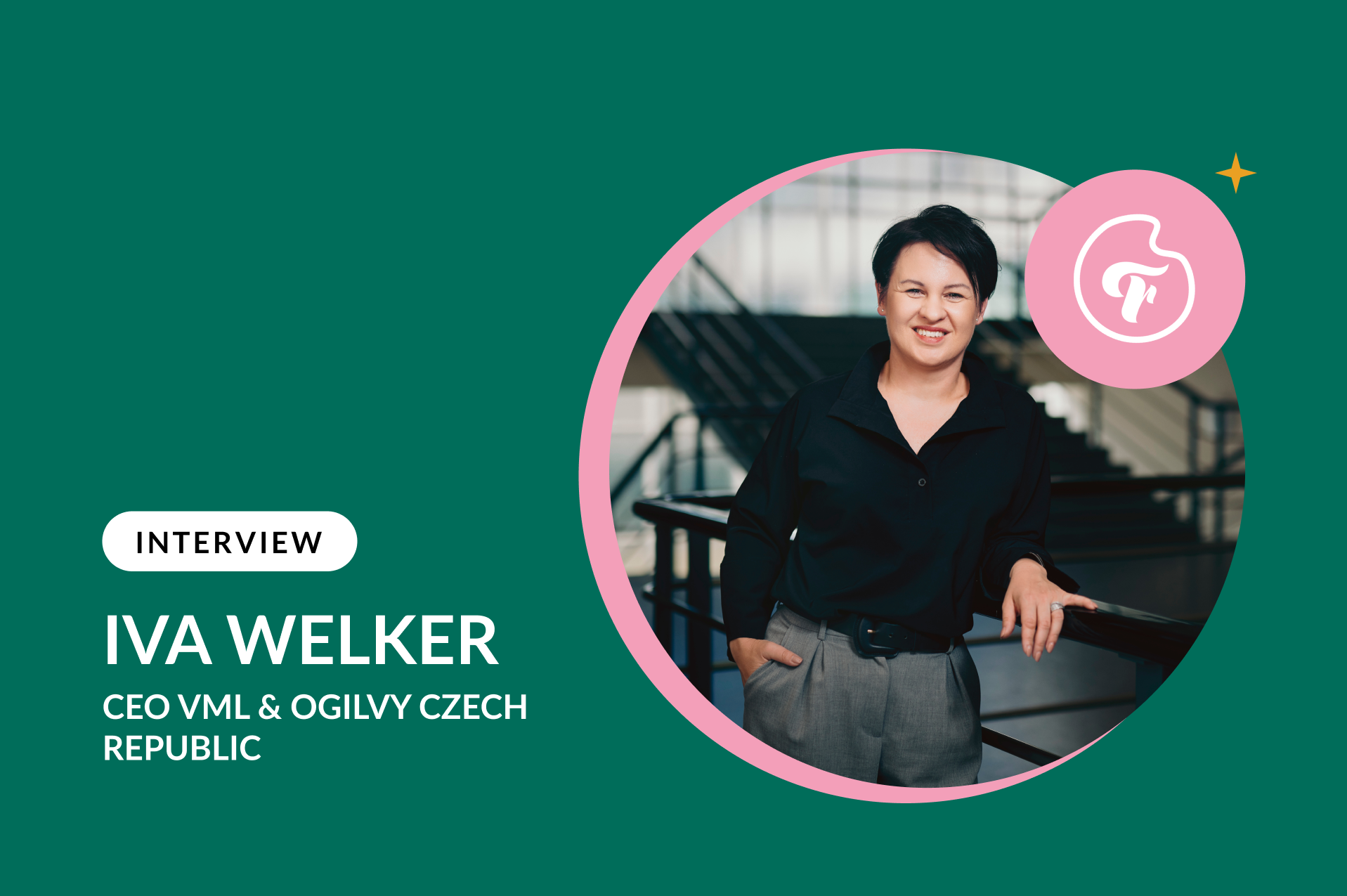
Iva Welker never planned to become a CEO. She found advertising almost by accident, started as an account executive, and kept saying yes to opportunities that stretched her. Today, as CEO of VML & Ogilvy Czech Republic, she shares what she’s learned along the way: how to tell a healthy stretch from burnout, how to lead people through change when you don’t have all the answers, and why leadership is less about position and more about the trust people already place in you. And if you’re hesitating over the bigger role, she has one piece of advice for you. Spoiler: don’t wait until you feel ready.
I never had a plan to become a CEO. I studied macroeconomics and found advertising almost by accident, when Terry Martin, then the head of Bates 141, offered me an internship in account management. I started as an account executive and kept saying yes to opportunities that stretched me. The moment I understood that others saw leadership in me came before any formal title: people started bringing me difficult situations, not because I had all the answers, but because they trusted me to stay calm, create clarity and move things forward. That was when I realized leadership is less about position and more about the responsibility people already place in you.
A stretch helps you grow when it has purpose, a degree of choice and realistic expectations. Burnout begins when everything is urgent, the extra effort becomes permanent, and people lose control over their priorities. I learned this partly the hard way: being reliable means people naturally give you more, and for a long time I treated that only as an opportunity. Today I ask teams to be explicit about trade-offs. If we add something, what moves, stops or gets support? Ambition matters, but sustainable performance is not the opposite of high standards. It is what makes them repeatable.
Day to day, it means communicating before you have perfect answers. During one merger, we learned about the global announcement roughly an hour before the press release went out. People still expected clarity from us. I learned to say plainly what we knew, what we did not know yet and when we would return with an answer. Then you have to listen, repeatedly, because the same change feels different to every person. What I get wrong is sometimes moving too quickly from explanation to execution. I may believe the direction is clear while others are still processing what it means for them. I have learned that repetition is not inefficiency but a necessity during change.
The goal is not to create one large agency. VML and Ogilvy remain two strong client-facing brands, each with its own history and reputation. What we are connecting is the engine behind them: leadership, expertise, technology and opportunities for people to collaborate. We try to be very clear about what should be shared and what should remain distinctive. The practical test is simple: does this make the experience better for clients and create better opportunities for our people? If it only makes the organizational chart look neater, it is probably not enough. We are connecting capabilities, not erasing identities.
My role is to create an environment for people to work and set a clear level of ambition. Bold work rarely arrives fully formed. It needs challenge, craft and protection from being “killed” too early. Our first Czech Cannes Lions Grand Prix for KitKat was a reminder that world-class work comes from diverse talent, strong collaboration and the persistence to take a good idea much further.
Honestly, I have rarely seen women held back by a lack of talent. More often, they feel they need to be completely ready before they put themselves forward. And I think we set the bar for ourselves high. I have seen brilliant women hesitate over a role while someone else, with less experience, simply steps in and says, “I can do it.” What makes a real difference is having people who notice your potential, encourage you and actively open doors. You do not need to become louder or tougher to succeed. In the end, what should matter is your ability, your judgment and the respect you earn.
Early in my career, I thought a leader had to know the answer and prove it quickly. Today I believe leadership is much more about asking the right questions, setting direction and creating the conditions for other people to take ownership. Control may produce short-term certainty, but trust builds a stronger organization. That does not mean stepping away from standards or decisions. It means being clear about the outcome, giving people genuine room to shape the route and accepting that their solution may be better than mine.
I have benefited from people who opened a door, trusted me before I felt fully ready and were honest enough to challenge me. Terry Martin gave me my first opportunity in advertising while I was still studying. Later, different bosses and colleagues invested in me by giving me real responsibility, not only advice. That has shaped how I mentor today. I help people see another perspective, turn ideas into action and stay calm in difficult situations. I also tell them something I learned personally: if you want an opportunity, ask for it.
AI is changing not only how fast we work, but also how we lead. If something that used to take days can now be done in minutes, the answer cannot simply be to ask people to do more. We should use that time to think better, be more creative and bring more value to clients. Of course, we also need clear rules around quality, copyright and data. But what must stay human is our judgment. It is about understanding the context, knowing what really matters and taking responsibility for the result. AI can give us ideas and help us work faster, but it cannot replace empathy, taste or courage.
The hardest part is that the work is never truly finished. There is always another deadline, client issue or idea that could be improved. My instinct is to take responsibility and keep going, so I have had to learn that energy also needs active management. I protect perspective through time with my family, travel, cooking, DIY projects and early walks with my dog. I try to recognize when I am no longer making better decisions, only faster ones. Being available every minute is not the same as being useful. A leader's energy affects the whole room, so taking care of it is part of the job, not a reward after the job is done.
Because careers do not grow through advice alone; they grow through access, networks and sharing examples. Opening the WPP Campus to Femme Palette was a practical way to connect women who are building their careers with a broader professional community and with one another. I also believe companies benefit when these conversations happen inside workplaces.
Apply before you feel completely ready. Very few people step into a bigger role already knowing how to do every part of it. Your task is not to prove that you are flawless. It is to show that you can learn, make decisions and grow into the responsibility. Be clear about what you want, because excellent work does not automatically communicate ambition. Ask for honest feedback, identify the gaps you genuinely need to close and do not invent extra ones for yourself.