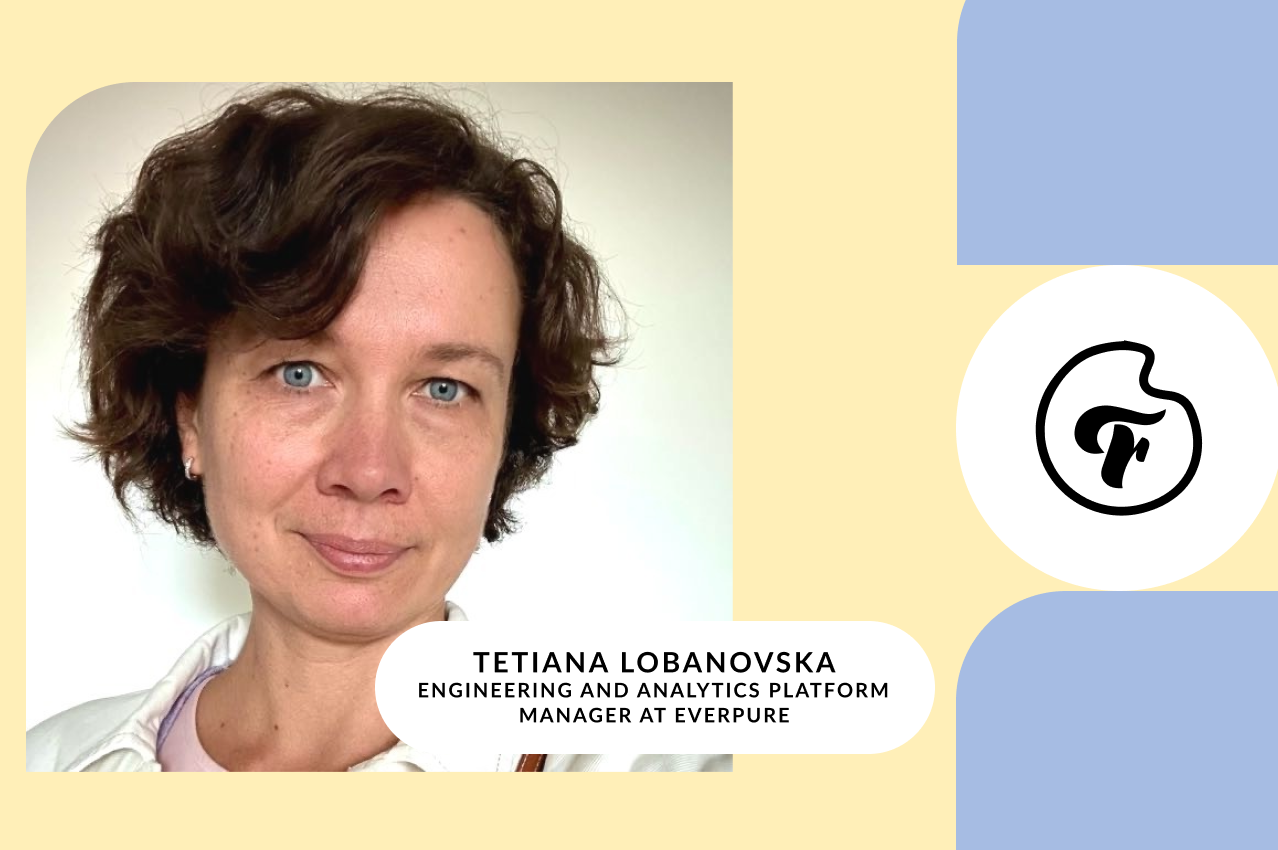
Tetiana Lobanovska knows what it looks like when an entire industry is figuring itself out in real time. As Engineering Manager for Analytics Platform at Everpure, a global data platform that helps organizations manage, protect, and unlock the value of their data at scale, she's been at the center of AI adoption, team transformation, and one very important question: what actually makes people valuable when the technology keeps changing? We asked her everything.
Honestly? Even with the rapid progress we’re seeing, this is still the very beginning.
I often compare it to electricity adoption 100 years ago. Back then, people weren’t convinced they needed it. They didn’t have an electric appliance at home. All worked on gas. Electricity was considered dangerous. Companies even had “Directors of Electricity” whose job was simply to figure out how to use this new thing.
AI feels very similar.We have powerful tools, but we’re still asking: what is this really for? The only difference? Speed. What took decades back then is happening in months now.
It means the most important skill is not what you know - but how quickly you can adapt.
The ground will keep shifting. That’s the new normal.
At Everpure, we call this a v1.0 mindset - accepting we’re at the start, not the finish line, and being ready to evolve with the technology. You can actually see this in how we’ve grown as a company. We started as a data storage business and over time became a data management leader. We didn’t stay fixed on what we were - we adapted to what the market needed next.
That’s what adaptability looks like in practice. And here’s the encouraging part: research shows women often score higher in skills like adaptability, emotional intelligence, and collaboration. In real life, that means staying calm when things change, connecting different perspectives, and working well with others.
Exactly what this era needs.
Three things come up often:
“I’ll be replaced by AI.”
“I’m not technical enough.”
“I don’t really belong here.”
These fears aren’t new. AI just made them louder.
A few simple truths:
No one is fully ready - the whole industry is learning as it goes.
Skills matter less than how fast you learn.
Confidence comes after action, not before.
And one more - most people have it far less figured out than they seem.
Don’t wait for the perfect moment. That moment when you feel fully ready? It’s not coming. Instead - start earlier. Learn as you go. Move forward, even if it feels uncomfortable. And sometimes, not knowing “how things are supposed to be done” can actually help you.
There’s a story I like - about a farmer who joined a 3-day ultramarathon for the first time. Experienced runners would run during the day and sleep at night. He didn’t know that. So he just kept running - day and night.
And he won.
Sometimes beginners win not because they are better - but because they don’t follow invisible limits.
My team and I learned this the hard way.
At the beginning, we asked:
“Where do you think AI can automate your work?”
Technically, it’s a valid question. But it doesn’t build trust. Because no one wants to be automated.
So we changed the question:
“Which parts of your work are important to stay with you? Which decisions should remain yours?”
And suddenly, the conversation changes. People open up. They engage. They start seeing AI as support, not threat. Because AI won’t replace us - just like Excel didn’t replace accountants. It reshapes how we work.
First - recognize that you are in a competitive space.
Research shows women sometimes choose not to enter competitive environments - not because they lack ability, but because they assess risk differently or prefer collaboration. So don’t step out by default. But also - don’t try to compete like someone else.
Instead, understand your own competitive strategy:
All of these can be effective! In the AI era, that last approach is becoming incredibly valuable.
So:
You don’t need to change who you are. You need to be intentional.
Because AI makes us efficient - but people make us creative.
At Everpure, we talk about whiteboard culture. Someone shares half an idea, someone else builds on it, and suddenly something new appears. That’s hard to recreate on a screen.
AI can give answers. But it can’t replace trust, spontaneous thinking, or the energy of solving something together. In a more digital world, human connection becomes more valuable, not less.
You’re not late. You’re early - at a moment when the rules are still being written. Be curious. Stay adaptable. Find people who support you. And don’t wait to feel ready. Even 100 years ago, “Directors of Electricity” were figuring things out as they went.
So are we.
.png)