Moving abroad for work sounds exciting. New country, new opportunities, new version of yourself.
And then something feels off. Not dramatically wrong, just slightly misaligned. You walk out of meetings thinking, "That didn't land the way I expected" or "Why is this taking so long?"
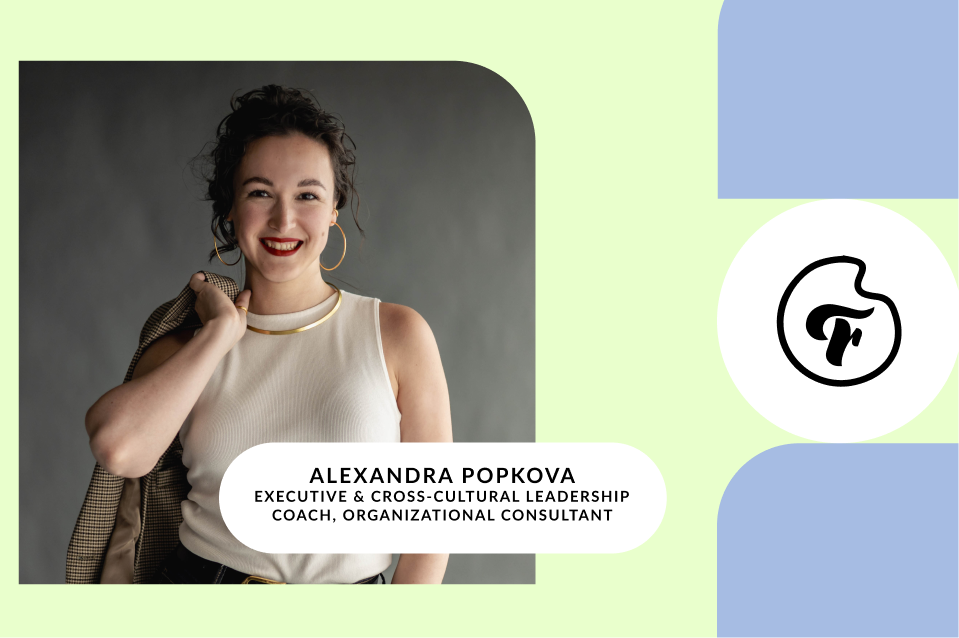
Alexandra Popkova knows that feeling well. As an Executive and Cross-Cultural Leadership Coach with 15 years of international experience and clients from over 35 countries, she has spent her career helping professionals navigate exactly this. As a Femme Palette mentor and contributor, she brings that same grounded, no-drama approach to everything she writes.
Here is what she has learned.
I remember one of my early experiences working in Latin America, coming from a Russian background where time and structure tend to be taken quite seriously. One of my team members had a client meeting scheduled at our office at 10am. He showed up on time, waited for about half an hour, and then left. At 11:15, the client walks in, completely calm. When I told him my colleague had already left, he looked genuinely confused and asked, “So… what should I do now?”
I will never forget that moment, because it made it very clear that expectations around professionalism, punctuality, and even what feels like basic respect… are not as universal as we think.
“Let’s discuss it tomorrow.” “Let’s catch up for a coffee sometime!” “The party starts at 5pm.”
Sounds clear, right?
But what do these actually mean?
Are you expected to follow up with your colleague tomorrow? Should you suggest a specific time for that coffee with someone you just met? Are you really supposed to show up to that party at 5pm… or is that more of a general idea?
The answers are not as straightforward as they seem. They depend heavily on cultural context.
Most of the confusion and frustration happens when your own cultural conditioning doesn’t match the environment you’re in… and you’re not aware of it. You’re interpreting everything through your own “normal,” assuming it’s shared.
That’s why one of the first things I always recommend if you’re thinking about moving abroad is to look into cultural frameworks and continuums. They can give you a starting point to understand how your background compares to the culture you’re stepping into.
They won’t give you all the answers, but they will highlight potential blind spots and help you anticipate where things might feel off.
And this becomes even more important in a professional setting, where your reputation, your effectiveness, and ultimately your livelihood are on the line.
Because time, communication, expectations… none of it is universal.
And if that’s true in social situations, imagine how much more complex it becomes at work.
I come from a background where being respectful meant being direct. Say what you mean, keep it efficient, move forward. Time is money. That was my default.
Then I started working in environments where respect, politeness, and even efficiency looked very different. People would build context first, soften messages, and expect you to read between the lines instead of saying things directly. And I remember sitting in meetings thinking, “OMG, why is this taking so long?” Meanwhile, the unspoken feedback (until it wasn’t anymore) was, “Why is she so rude and direct?”
One moment that really stayed with me happened early on in Latin America. I pitched a project idea to my manager, very structured, very clear, very… me. Her response was, “Yes, I think that would be difficult to make happen.” Then silence.
I asked again for feedback, thinking maybe I hadn’t explained it well enough. She repeated the exact same sentence. I left that conversation genuinely confused.
In my mind, “difficult” didn’t mean “no.” It meant challenging, but still possible. So I kept pushing. “I understand it might be challenging, but I’m willing to take on the risks and I genuinely think I can deliver the result… so can I go ahead?”
After the fifth round of the exact same response, it finally clicked. As you can imagine, I had a lot to learn. I was hearing the words, but missing the meaning behind them.
And that’s a big part of cross-cultural communication. It’s not just what is being said, but how it’s being said and what’s implied underneath. If you don’t understand that layer, things will feel off, even when everything sounds perfectly “clear.”
If you want to get a better sense of where your communication style sits and how it compares across cultures, a few frameworks are actually very helpful:
You don’t need to memorize any of this. But even a basic awareness shifts your thinking from “this doesn’t make sense” to “this makes sense… in a different system.”
This one truly deserves its own category.
You present something. People say yes. You leave thinking, “Great, we’re aligned.” Or you speak to a potential client and hear, “Yes, I’ll review this tomorrow,” “I’ll call you tomorrow,” and you take it at face value.
But what does that “yes” actually mean?
Sometimes it means exactly what is said. And sometimes… it means the complete opposite.
The tricky part is: how do you know?
Part of the answer is understanding the cultural context you’re in. Where does it sit within the communication spectrum? (If you haven’t yet, this is where frameworks like the Cultural Map really help.)
But in practical, everyday terms, the key is this: you stop guessing, and you start calibrating.
Instead of asking, “Are we aligned?” (which will almost always get you a “yes”), you ask different questions. More specific ones. More grounded in action.
For example:
These questions shift the conversation from polite agreement to actual clarity.
Because in many cultures, “yes” is not about commitment. It’s about maintaining the flow of the interaction… and often, even more importantly, the flow of the relationship.
Saying “no” can feel too direct, too confrontational, or even disrespectful. In some contexts, it’s something people will actively avoid, even if they completely disagree with you.
So instead, “no” might sound like:
…followed by silence or ignored follow-ups.
Once you start recognizing these patterns, things begin to make a lot more sense. You stop taking it personally, and you start navigating the situation with a lot more awareness and intention.
This one might be a hard one, because it might mea you have to shift how you approach interactions almost completely, from head to toe.
Coming from a more task-oriented background, my “default settings” were simple: be efficient, get things done. Relationships will build along the way. They’re not the priority. Results ARE!
And in some environments, that works. In others… it really doesn’t.
I’ve seen projects slow down, not because people didn’t care or weren’t capable, but because that relationship layer simply wasn’t there yet. And I’ve also seen the opposite. Once trust was there, things started moving much faster, sometimes almost surprisingly fast.
For example, in Latin America, taking the first 10–15 minutes of a business meeting to talk about the weekend or family updates is not small talk. It’s part of the agenda. It builds the connection that the work then stands on.
In some cultures, building relationships and being liked is not a “nice to have.” It’s the strategy. Instead of sending another follow-up email or a polite reminder about deadlines, inviting your colleague for a coffee and talking about life, family, or their hobbies might actually move things forward.
And then there’s the other side of it.
If you take that same approach into a more task-driven culture, it can come across as irrelevant, inefficient, unprofessional, or just a bit too personal for a business context.
Same behavior. Completely different outcome.
And that’s where things start to get interesting.
This one is less about silence itself, and more about the shared context behind communication.
Because here’s the thing: in any culture, a lot of communication doesn’t actually happen through words. It happens through what everyone already knows, what’s assumed, what doesn’t need to be explained. And that works… as long as you share that context.
If you don’t, this becomes a tricky one.
It’s very natural to focus on what is explicitly said in the room. If no one raises concerns, no one challenges the idea, no one asks questions, it feels logical to assume you’re aligned. But that’s where things often go wrong, because you might be missing half of the conversation.
Not because people aren’t communicating, but because you don’t yet fully understand the rules of that communication system.
In some cultures, disagreement is softened. In others, it’s delayed. In others, it’s expressed indirectly, in a different setting, or even through someone else. So what sounds like agreement on the surface might actually mean, “I hear you, but I’m not convinced,” or “I don’t feel comfortable saying no in this setting,” or “This needs more discussion, just not right now.”
And if you don’t share that cultural context, you simply won’t catch it.
That’s where most misunderstandings happen. Not because people are unclear, but because you’re reading the situation using your own “rules,” assuming they are universal.
So the shift here is important. Instead of only listening to words, start reading the full context. Pay attention to how quickly people respond (or don’t), whether feedback comes later and in what format, who speaks and who doesn’t, and what gets said directly versus indirectly.
And most importantly, help yourself not to assume. When in doubt, ask someone who understands the context better. A local colleague or someone more experienced can give you perspective you simply don’t have yet:
Because when the shared context isn’t there yet, you have to build it. Otherwise, you might walk out of the room thinking everything is clear, while everyone else is having a completely different conversation in their heads.
This one is uncomfortable, but important.
When you move abroad, it’s very easy to stay anchored in your default way of communicating: same tone, same expectations, same structure. It’s what feels natural, what has worked for you before, what feels like “the right way” to do things.
And when things don’t land, the thought comes quickly: “They just don’t get it.” It’s a very human reaction, and yes, I’ve had that thought too more than once.
But over time, something shifts. You start realizing it’s not about who’s right, it’s about what actually works in this context. And that’s where the real adjustment begins.
You don’t need to lose yourself or completely change who you are, but you do need to expand your range. And this is also where things can feel challenging, because it often becomes a bit of an identity journey, not just a communication adjustment. You might start questioning what is “you” and what is just habit or conditioning, and that’s not always comfortable. Getting external perspective can really help here, whether through coaching, mentoring, or simply speaking with people who have already gone through a similar transition.
At the same time, it helps to step back and ask yourself: what’s the end game here? What result are you actually trying to achieve, and what strategy will help you get there in this specific context? That shift in focus can reduce a lot of frustration and help you stay focused on what really matters.
Because in the end, cross-cultural work is not about proving a point, it’s about creating understanding, and that requires flexibility.
It’s not about changing who you are, but expanding and building your own toolbox, something you can draw from depending on the situation and context. And just as importantly, making it your own. Finding your voice in these new ways of showing up.
Because this is a process, and at some point it can feel frustrating. You might find yourself asking, “How do I adapt without feeling like I’m losing or betraying myself?”
That’s part of it.
Living and working abroad will challenge you in ways no training or course can fully prepare you for. Not because you’re doing something wrong, but because it’s not just about learning a new system.
It’s about realizing that your “normal” was never universal to begin with.
And once that clicks, something shifts. You stop taking things personally, you start observing more, adjusting more intentionally, and navigating situations with a bit more ease… and definitely a bit less frustration.